
| Index of articles from the Blog |
| Animals |
| Anthropology & Archaeology |
| Art & Cinema |
| Biography |
| Books & Authors |
| Culture |
| Economics |
| Environment |
| Fiction & Poetry |
| History |
| Humor |
| Justice |
| Philosophy |
| Photography |
| Politics |
| Religion |
| Science |
| Travel |
Books by
Books by
|







|
||
|
||
|
So begins Herodotus' account of the famous battle of antiquity between the Persians and the Greeks in early fifth century BCE - perhaps the first systematic and conscious undertaking in the Western world to assign rational cause to effect in the sphere of the sociopolitical. To a minority of Athenians, the supernatural and the mythical seem inadequate explanation for human events. Gone are the Gods with their constant meddling in the affairs of mortals - the emphasis shifts firmly on the actions, character, and motivations of men. And they insist on a coherent narrative. |
 |
|
|
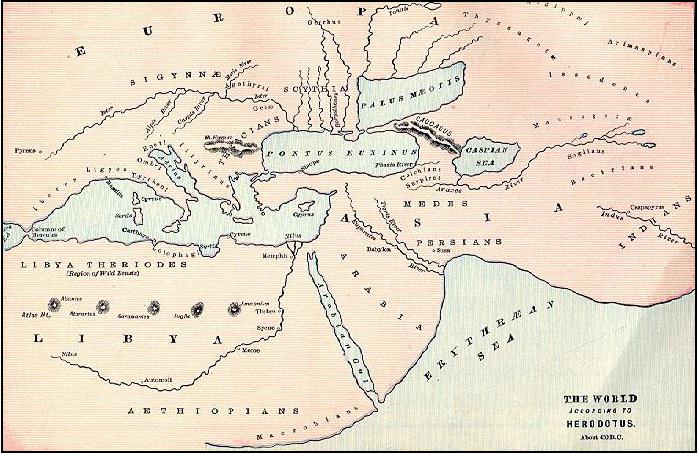
Herodotus was born in 480s BCE in Helicarnassus, a Greek settlement of Ionia (northwest Turkey), then under the suzerainty of Persians. Ionia was the center of an early intellectual enlightenment, due in no small measure to the region being at the crossroads of many cultures and traditions. Raised in this 'multi-cultural' environment, which led to his relative emancipation from narrow Greek chauvinism, Herodotus moved first to Samos and then to Athens as a young adult where he lived during its golden age, the reign of Pericles. He died before, or soon after, the start of the Peloponessian war in 431 BCE. Herodotus traveled widely to gather facts and opinions about the Greco-Persian war, alongside documenting the manners and customs of peoples - besides the war, his other aim was nothing short of mapping a complete ethnography and geography of the non-Greek world. What motivated him to undertake such a gigantic effort? With few written records, one imagines him painstakingly gathering details on events decades earlier, corrupted no doubt by hearsay and the self-glorifying chauvinism of victors, particularly in a society rife with superstition and nationalism. What in his outlook and judgment is still noteworthy nearly 2,500 years later? What society was he a product of? What can we say about his methods, concerns, and objectivity? In other words, how should we evaluate Herodotus as a historian? |
Next: The Beginnings |
Designed in collaboration with Vitalect, Inc. All rights reserved. |
|