
| Index of articles from the Blog |
| Animals |
| Anthropology & Archaeology |
| Art & Cinema |
| Biography |
| Books & Authors |
| Culture |
| Economics |
| Environment |
| Fiction & Poetry |
| History |
| Humor |
| Justice |
| Philosophy |
| Photography |
| Politics |
| Religion |
| Science |
| Travel |
Books by
Books by
|




(This story appeared in Travelers Tales: Best Travel Writing 2007) |
||||||||||
|
I am six hundred miles east of the Great Barrier Reef in the archipelago of Vanuatu-or, as they say in Vanuatu, the "ni-Vanuatu" archipelago -- home to nine active volcanoes. One of these, Mount Yasur on the southern island of Tanna, is said to be the most easily accessible live volcano in the world. Anyone can walk right up and peer down into its fiery belly. A real volcano: fire and brimstone and flying ash. It is late in the dry season when I get to Tanna with my friend, Michael. The days are crisp and warm, the nights cool enough to require long pants and a sweatshirt -- a departure from the perpetual warmth of Ambae, more famously known as Michener's "Bali Hai," which is the more northerly island, just shy of the equator, where I have lived and worked for eight months as a Peace Corps science teacher. We plan to spend three days at Port Resolution, and then head up to Ienemaha, the village closest to the crater, where Michael's tenth-grade student, David, lives. David adores Michael as his teacher and a living soccer maestro, so his family graciously asked us to be their guests for a couple of days.
When we drive across the ash flats that flank Mount Yasur, its black cone smoking above us, our fellow passengers provide details about the mountain's random acts of carnage: Three years ago, a tourist and her ni-Vanuatu guide were both burned alive near the crater's lip when gobs of molten lava rained down on them. After that, the ni-Vanuatu government shut down tourist access to the volcano for two years. With animated gestures and vivid language, the children describe further particulars: how half of the guide's body was found, the right side of it burned away; how the woman, well. had lost her head; how, more recently, a local village boy befallen by a blob of brimstone lived long enough to be carried back to his village, his one leg burned away below the knee. He did not last much longer, lacking access to more advanced medicine than his village could provide. I look at Michael with fresh trepidation, and I can see he shares my thoughts. Oblivious to our fears, a fine-faced boy brightens up and asks me, "Have you heard the good news?" I have heard this before from ni-Vanuatu children; the first time, it stumped me, but I learned that it is always followed by, "Do you know about Jesus?" I evade the question. "Yes," I reply with a smile, "I've heard it." Until the latter years of the nineteenth century, the islanders, themselves, had never heard the Good News. But when missionaries arrived to help colonize the islands in the nineteenth century, a veneer of Christianity spread rapidly over the indigenous animism. And, for the most part, the ni-Vanuatu still practice a Christianity that seems to have changed little in a century. To sit on decaying benches in an unlit, unadorned, square wooden church, surrounded by the steamy breath of vivid green forest, to hear old Anglican hymns sung in the spontaneous, nasalized harmonies that characterize the traditional vocal style, one imagines a fervent, sweating missionary might any moment swagger to the front of the assembly. But things have changed; Bibles are now printed in Bislama, and the islanders have made this religion their own.
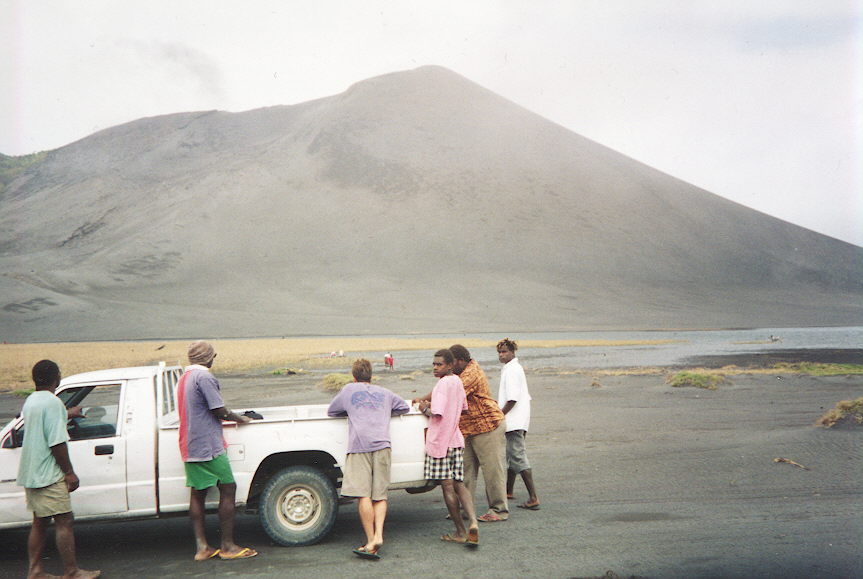
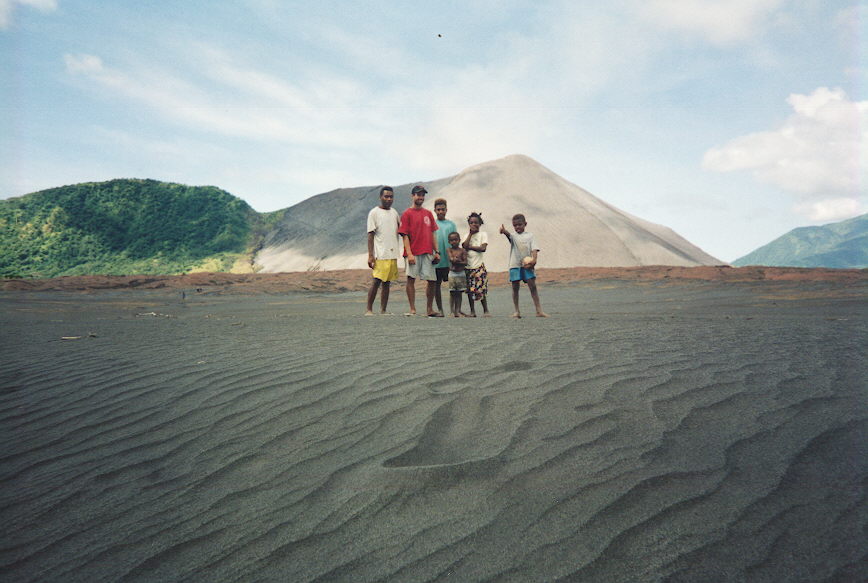
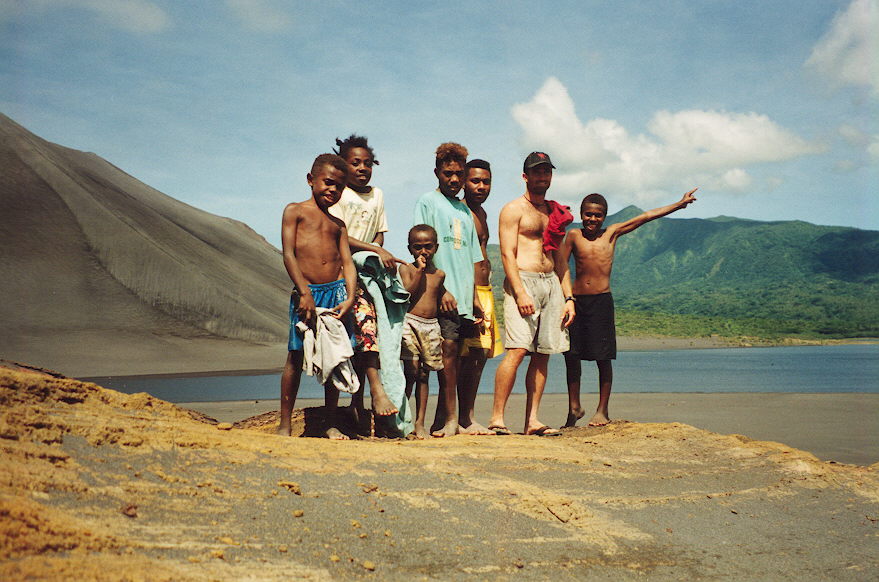
At Port Resolution Guest House we are shown to our round bungalow. Spacious, with latticed strips of wood for walls under a thatched roof, it contains only two beds and a small table. Accustomed as we are to the lack of electricity and heated water, the bungalow feels luxurious for the mosquito netting covering the beds. Out front lean two wooden lounge chairs, overlooking Port Resolution bay, a circular body of placid, azure seawater, ringed by a mango colored ridge that once demarked a volcanic crater. Had I just arrived to this place from the United States, I might have imagined it the most picturesque and serene spot on earth. Paradise. But I came from Ambae -- likewise a "paradise," surrounded by the clearest water in the world, water warm as a baby's bath, swarming with vibrantly colored creatures that harbor and hunt in its offshore reefs -- and I already know the limits of this metaphor. Already, I had learned to watch out for cone shells and sea snakes near the beaches, to guard vigilantly against malaria, and to lock my door at night. Lounging in the sun, we hear the far away booming of Mount Yasur. But for the present, we focus on the tranquil beauty of the bay, and wonder about the resident dugong -- a large, marine mammal, cousin to the manatee -- who is said to enjoy playing with swimmers. "You notice, the local people don't get in there to swim," Michael observes one afternoon. "It's only the tourists who talk about it." It is true. We have met a dozen tourists at the guesthouse -- French, Australian, Kiwi, American -- who speak excitedly about their attempts to flush out the dugong. We watch them swim around the bay in large circles, in search of the elusive creature. We hear them clap and slap the water, following the example of their ni-Vanuatu guides, to rouse the old guy. Still, though the guides happily demonstrate how to "call" the dugong, they never venture into the water themselves. Children never wander in above their waistlines. Fishermen stay in their canoes. Only the tourists swim here, to whose chagrin, the dugong does not appear. In the guesthouse book, we read of past encounters with the dugong and the wistful regrets of tourists who missed him. Some have seen him from a distance or even turned a few delighted circles with him. Others give warnings explicitly or implicitly couched in their tales: keep your distance; do not attempt to touch him; get out of the water if he swims straight toward you. One marine biologist emphasized his point with capitals: REMEMBER THAT THIS IS A LARGE WILD ANIMAL. HE IS NOT TAME. HE IS NOT PLAYING WITH YOU. I am increasingly convinced that an encounter with the dugong is not to be taken lightly, any more so than an encounter with a wild elephant. Listening to more tourists eager to jump in, I am struck by how blithely we pass through here, as though this really is a Paradise: a benign and thrilling place, here to serve our wishes. But the Western dream of a clean, safe, ordered world is not more well met in Vanuatu than it is in most of the world. In the guesthouse we also hear stories from those who have climbed the volcano. They went up by jeep at night, when the fiery glow is most stunning. They hiked the last ten minutes to the top and stood around for a few minutes, waiting for something to happen. But Mount Yasur has been quiet lately, so there are few tales of spewing lava. One couple says they laid out their bags and slept overnight a few feet from the crater. When I ask if they had been scared, imagining clumps of molten rock raining down on them in their sleep, singeing holes through their bags then their flesh, as the high-tech, synthetic materials ignite, they laugh dismissively as though I am naïve: Bad things will not happen to them; they are Westerners on holiday. It is our last morning at Port Resolution when a young couple arrives with a bevy of local men who had promised to show them the dugong. They clap and slap and out of nowhere a fat, grey body slides into view under the perfectly transparent skin of the water. He looks about the size of a rhinoceros. Clearly, the young man considers this opportunity a highlight of his life, given the gusto with which he dives in behind the creature. At first the dugong shows little interest in him, so the young man -- an athletic swimmer -- draws up behind him. But the dugong, at home in his element, casually evades the swimmer, who laughs and keeps up chase. Within minutes, however, the game has changed, and it is the dugong chasing the swimmer. He laughs until the dugong makes contact, ramming him in the gut and rushing him backwards through the water. When the dugong moves off, the swimmer appears stunned at his unexpected loss of control, at the unexpected aggression of the dugong, and he moves back towards the shore. Before he reaches it, the dugong is upon him again, having circled round to his front, shoving him forcefully and speedily backwards. The girlfriend on shore looks frightened. And when the dugong releases him and he recovers his breath, the boyfriend swims as fast as he can for the rocks. The dugong comes at him a third time, and the man flails awkwardly, yelling wildly for help. His girlfriend is at a loss, dropping to her knees at the water's edge, and his ni-Vanuatu guides, till now clustered on shore, talking amongst themselves, take notice of their man's situation and chuckle nervously. No one, though, is ready to jump in, not even his girlfriend. I expect the dugong has never killed or seriously injured anyone. He is, after all, a vegetarian. But he makes a clear point that he is nobody's pet and no human is in control here. This place is not paradise, for paradise is a human creation, and this place yet exceeds our human imagination. A fisherman glides by in his outrigger canoe, and the men on shore coax him to pick up the panicked swimmer. The fisherman complies without speaking, his eyelids fluttering with annoyance. As soon as it comes within range, the swimmer grabs the narrow front of the canoe and desperately tries to pull himself aboard. This capsizes the small craft, and swimmer, fisherman, morning's catch, and fishing gear are plunged into the clear brine. The fisherman sighs as the swimmer still scrabbles with mad futility to mount the upturned hull. By now the dugong has swum off, and the men ashore are roaring with laughter. I am relieved the man is not hurt, but I wonder what stories this couple will tell their friends back home. Later this same morning, David arrives with his father, sisters, and some friends. We head on foot across the island to Ienemaha. For two hours we hike up and down narrow, forested ridges, between stands of ferns thick and tall as trees. And as we move toward the volcano, we hear more of its clamor. By the time we reach Ienemaha, we smell sulfur lightly on the breeze. The muted rumbling of the volcano blends with the rustle of leaves, the call of birds, and the voices of playing children, occasionally giving way to a fierce, guttural blast. As soon as we arrive, the village boys are eager to play soccer with Michael, and they lead us down to the beach. Michael has carried his surfboard the entire way, an unshakable habit of his San Diego heritage; he is on a quest for the right wave in Vanuatu. So far, no luck: At Lamen Bay on Epi, where he lives, the waters are calm and he had taken to using his surfboard as a fishing canoe. He ended this practice and purchased a tiny outrigger when once, his feet dangling over the edge of his surfboard, he struggled with the monster on the end of his fishing line and realized he had snagged a small shark. Now he looks at the rolling surf with relish, though it still is not as high as he prefers. I converse with the children in Bislama until they became incoherent with giggles. Then they whisper to each other in their local language, which is completely opaque to me. Before the missionaries and blackbirders and colonists came to these islands, before the populations were decimated, these islands were populated with nearly a million people speaking over a thousand different languages. The fractionation of languages is attributed to the rugged terrain and the surprising fact that, in this land of natural abundance, the traditional cultures were extremely warlike. Apparently, the combined onslaught of Christianity, blackbirding -- kidnapping youngsters for the slave trade -- colonization, and population decline subdued this aspect of their culture, but most of the original languages have died out. Yet even today, the ni-Vanuatu archipelago is home to one of the highest ratios of languages to people in the world. Some 170,000 people speak over a hundred surviving languages.
Like nearly all ni-Vanuatu, David's family subsists primarily on traditional horticulture. The garden plots take a fair amount of tending, which is women's work, but the gardens are probably smaller than they traditionally were, since now the table is supplemented with foreign foods such as rice, tinned beef, and Top Ramen, more cosmopolitan cuisine than the staples of taro, manioc, yams, plantains, and the enormous variety of local fruits, vegetables, greens, and seafood. But the most prized food is the occasional pig or cow that gets slaughtered for special occasions. In preparation for our morning walk to the foot of the volcano, I steal a moment to dash fifty meters down the path to the local store for film. Like most island stores in Vanuatu, this is a square wooden shack with mostly -- empty shelves built onto the walls. Luckily, this one has a few boxes of film for the volcano tourists, like me. After dinner, David's father takes Michael away to drink kava. Michael does not relish it, but, being a man, it is expected that he should go. As I settle down with a book and a hurricane lamp, David's mother knocks and steps in for a chat. She entreats me not to run off by myself again. "I have two daughters, and there is a whole village full of girls. Just ask one of them to come with you if you want to go somewhere." She stresses that they do not want me to get hurt, not to fall, for instance. And then she reminds me of the devils in the forest. I have heard this before. On Ambae I am warned often that I should not leave the village alone, that I should be cautious of ol devil who inhabit the surrounds. But this is an injunction I routinely ignore; I walk by myself nearly every day. Still, I have become more hesitant about it, experiencing that, in this culture, a lone woman is fair prey to any group of young men who might wish to exert their will over her. Already I had been chased and grabbed a number of times in various situations, fortunately, never when I was alone in the forest. Listening to David's mother's sincere concern, it occurs to me that groups of roguish boys might be the very "devils" that the women are trying to warn me about. David's mother also talks about the ancestors who live in the volcano. They sleep in there most of the time, she says. Sometimes they wake up, and that is when the real pyrotechnics begin. She cautions me to be quiet when we ascend the volcano, so as not to disturb ol bubu. I cannot sleep in the cool night air; after months on Ambae, Tannese nights are too cold. When Michael returns, we lie awake in the darkness, listening to the rumbling of the island below and around us. "Are you sure you want to go up there?" he asks. "It's kind of crazy. We don't have to go." I am scared, I tell him, but also certain. At his suggestion, we make a pact: If either one of us gets too scared to go all the way up, for any reason, at any point, we will both turn around and come back down together.
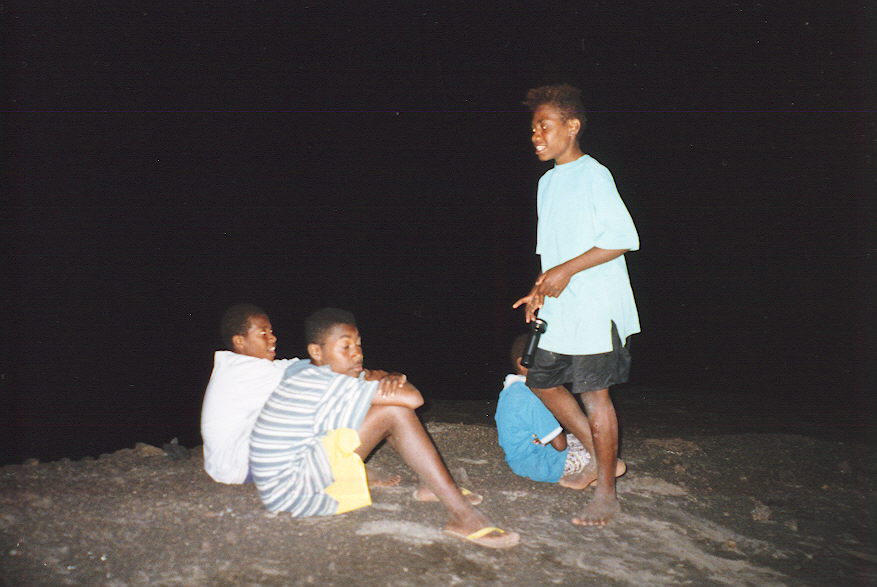
Beneath the stark landscape, the earth rumbles; the volcano's power is inescapable. It is impossible not to feel small. I watch the children chasing the ball with Michael, laughing and playing; they look up now and then, glance at Yasur's smouldering crown. This is a special place, somewhere close to the beginning of the world, a place where creation and destruction feel the same. Fire is like life, disembodied. And a fascination for volcanoes is ancient and universal among those who live around them. They are touch points with the divine, the dwelling places of gods and spirits. The goddess Péle of the Hawai'ian islands, the Roman god Vulcanus of Vulcano, and ol bubu of Mount Yasur are only a few among them. After soccer, the children run into the stagnant pool and swim before the bone white branches of the trees. Perhaps these children already understand something of death. I sense it is not alien to them, not separate. These girls and boys will not be blindsided by the apprehension of their mortality one fine day in mid-life, as we are in the West, witnessing the death of a parent or friend, feeling our bodies dry up. Here, life and death surround them; their lives, the life of their whole community, is poised in between, at the mercy of spirits, magic, and other mysterious powers. Neither will these children grow up to share our illusions of safety, of dominion, of control. Every day tells them that they are only human, small compared to what lies around them, and strength lies in numbers, in community. In the West, we expect the opposite: that strength lies in our individuality; that we are at the top of all things. It is too soon after dinner that we start back to the volcano that evening. My stomach is overfull with our hosts' generosity. I bring my flashlight, but one of the older children commandeers it for the walk. They grew up in these long, black nights, and can see in it far better than we can. They walk easily in the darkness and flick on the torch only for a micro-second, if something large is in the path. Emerging from the forest onto the ash plain, no feature of the landscape is visible to me in the moonless night. Only Yasur's luminous, amber halo looms in the sky above us, Venus and Saturn standing as sentinels to each side. It is alive, a breath of fire from blackness. We make our way across the rough ground. The ascent starts immediately and steeply. The children stop us after a few feet, reminding us to be quiet as we walk; no laughing. And then the way grows steeper, though we follow a path of sharp switchbacks. We are ascending the "backside" of the volcano. This is the way the locals go up, not the trucks carrying tourists. On the other side of the volcano, the truck path goes nearly to the top. But we have a long climb ahead of us. Maybe it is twenty-five minutes, but it feels like forever, walking blind up a sharp incline, beneath us the ash sliding down from our footsteps into nothingness. The cone is so steep, tipping to one side, I could sit against it; leaning away from it will send me tumbling to oblivion. But we do not rest on the ascent. My rugged sandals are a liability in the deep ash, so I remove them and sink my ankles into its warmth. As we climb higher, more chunks of dried lava litter our invisible path, and the hillside heats up beneath my feet; the crust is thinner near the top. The slope ends abruptly, and we are standing on the crater's flat lip. A few feet in front of us yawns its cavernous mouth, nearly a perfect circle. The inner walls are illuminated by the glow of lava somewhere deep below. We approach the mouth cautiously until the children tell us to stop. Standing three feet from the edge, I lean over. Anxiously, children grab each of my hands and lean back. I am contained, held by them.
Yet it is not long enough. Michael interrupts my meditations. "I have a bad feeling about being here," he says. "Let's go." For the sake of the promise, I follow him. Our descent is rapid. Following the children, we slide and skid haphazardly through the loose ash, running blindly down the cone, like falling. When we hit the flat, we keep moving without words, swimming through the darkness to the edge of the forest. And there we sit on a craggy stone, looking back at Yasur's halo. We are not seated more than a few seconds when the volcano lets out a momentous boom. Great, glowing whirls of lava explode from its mouth. We watch them twist skyward, searing light and dark as their surfaces cool and break open again. The largest of the globs leers leftward and thuds finally down on the crater's lip, the very spot where only minutes before we were standing. No one says anything as we watch the lava cool and darken until it is invisible in the night. Elation comes over me. Awe. Wonder. I am completely alive within the bounds of my pressing mortality. Around me, the children share my secret of life in death. And this binds us, binds all people, I know then. Michael looks at me somberly. "Good call," I whisper. He nods. |
Designed in collaboration with Vitalect, Inc. All rights reserved. |
|